
Almost everyone who tries Scripture memory has lived the same small tragedy. You pick a verse. You work at it for an evening, and by bedtime you can say it perfectly. A week later at Bible study, you still have it — a little slower, but there. And two months after that, someone mentions the reference and you realize, with a kind of quiet embarrassment, that it’s gone.
The usual conclusion is I’m just bad at memorizing. The actual explanation is better news: you memorized fine. You reviewed wrong — or, more likely, nobody ever told you that reviewing was the job. Spaced repetition is the fix, it’s over a century old, and using it is no more unspiritual than using a bookmark.
What is spaced repetition?
Spaced repetition is a way of reviewing what you’ve learned at increasing intervals — after a day, then a few days, then a week, then a month — so that each review lands just before you would have forgotten. Instead of repeating a verse twenty times tonight, you recall it a handful of times spread across weeks. Same effort, radically different result: massed repetition builds familiarity that decays in days, while spaced review builds memory that lasts for years.
Concretely: you learn Philippians 4:6 on Monday, taking ten minutes to get it word-perfect. Tuesday, you recall it once from memory — thirty seconds. You recall it again Friday, again the following Friday, again a month later. Five brief encounters, and by the last one the verse is on its way to permanent. The twenty-repetitions-in-one-night approach spends more total effort and loses the verse by February; the spaced approach spends less and keeps it for years. The schedule, not the sweat, is what does the work.
The idea is not modern productivity culture. Teachers were spacing recitations long before anyone measured why it worked. What the last century added is the measurement — and it turns out the effect is one of the most consistently replicated findings in the psychology of learning.
The forgetting curve: why verses fade
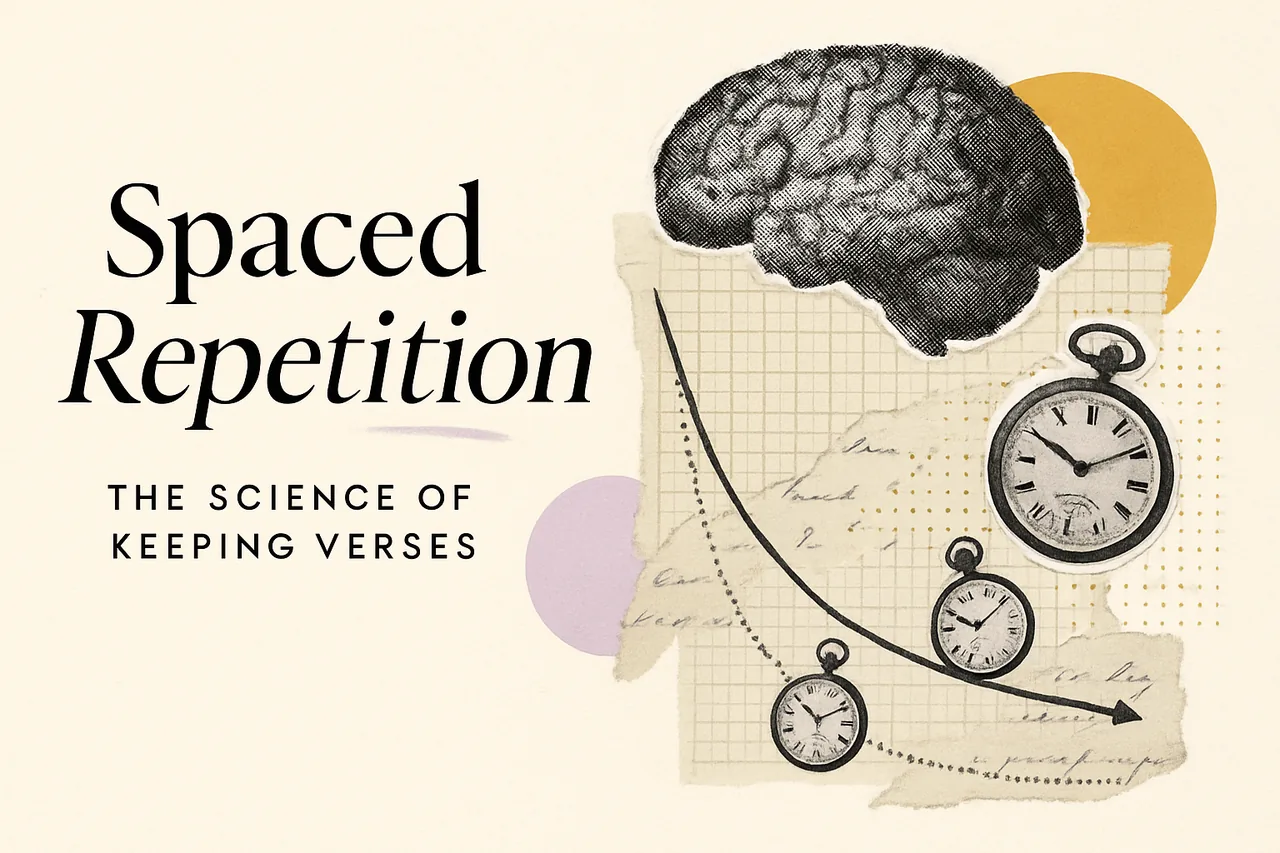
In 1885, a German researcher named Hermann Ebbinghaus published Über das Gedächtnis (“On Memory”), the fruit of a famously tedious experiment on himself: he memorized thousands of nonsense syllables and tracked how quickly he forgot them. The result is what we now call the forgetting curve — after you learn something new, recall drops steeply within the first days, then continues sliding toward zero.
Your brain is not malfunctioning when it does this. It’s triaging. You encounter enormous amounts of information every day, and a memory that never gets used again is, from your brain’s point of view, safe to discard. A verse practiced only once, however sincerely, lands in the discard pile with everything else from that Tuesday.
Here’s the part that matters: every successful review resets the curve — and flattens it. Recall the verse tomorrow and the next decline is slower. Recall it again in three days, then a week, then a month, and the curve keeps flattening until it’s nearly horizontal. That’s what “knowing a verse cold” is, mechanically: a forgetting curve you’ve beaten flat through well-timed remembering.
So when Psalm 119:11 speaks of storing up God’s word in the heart, the image is more apt than the psalmist could have measured. Storage isn’t a single deposit. It’s a practice of returning.
Active recall: why testing yourself beats rereading
There’s a second finding you need, because it explains why so much sincere effort produces so little retention: reading a verse again is not reviewing it.
When you reread, the words are in front of you and your brain recognizes them — a warm, fluent feeling that’s easy to mistake for knowing. When you recall — the text hidden, dragging the words up from memory — you’re doing something entirely different, and vastly more effective. Psychologists call it the testing effect. In a well-known series of experiments published in Psychological Science in 2006, researchers Henry Roediger and Jeffrey Karpicke compared learners who practiced retrieving a text against learners who spent the same time rereading it. A week later, the retrievers remembered dramatically more — even though the rereaders had felt more confident all along.
The act of retrieval is what strengthens the memory. Struggle is not a sign it’s failing; struggle is the exercise.
Practically, this means the center of your practice should always be attempting the verse from memory:
- Cover the text and try. Peek only when stuck, then try again from the top.
- Use first letters. Write just the first letter of each word and recite from that scaffold — enough help to keep you moving, little enough that you’re still retrieving.
- Say it aloud. Speaking recruits your ears and your mouth’s muscle memory alongside your mind.
Rereading is comfortable because the answer sits in front of you; retrieval is uncomfortable because it doesn’t. That discomfort isn’t a problem to eliminate — it’s the very signal that a memory is being forged.
The expanding schedule
Put the two findings together and you get the whole method in five lines:
- Learn the verse today — read it aloud, then recall it from memory several times before you stop.
- Recall it tomorrow. One honest attempt from memory. Check yourself against the text.
- Recall it again in about three days.
- Recall it again after a week, then two weeks, then a month.
- Every time you succeed, stretch the next interval. Every time you fail, shorten it and rebuild.
Each review takes under a minute. That’s the trade spaced repetition offers: a few dozen well-placed minutes across a year, instead of relearning the verse from scratch every time you need it.
Notice what the schedule implies about effort. The work of Scripture memory is not concentrated in the day you learn a verse — that’s the easy part, and it was never the problem. The work is distributed across the weeks afterward, in reviews so short they hardly feel like work at all. This is also why a year-long structure serves memorization so well: a 52-week memorization plan naturally builds the review rhythm in.
A manual system that works (no app required)
You can run all of this with a box of index cards — the verse packs in shirt pockets and recipe boxes on kitchen counters long predate any app, and they built formidable memorizers.
The verse-box rotation:
- Write each verse on a card — reference on one side, text on the other.
- Divide the box into four sections: Daily, Weekly, Monthly, and Quarterly.
- A new verse starts in Daily. Each day, recall every card in the Daily section from memory.
- When a card feels solid for about a week, promote it to Weekly. Review that section once a week — pick a fixed day, or split the section across weekdays.
- Keep promoting: solid for a month → Monthly. Solid beyond that → Quarterly.
- Miss a card? Demote it. No shame in it — a stumble just means the interval got ahead of the memory. Back one section, rebuild, promote again.
That’s a real spaced-repetition system, and if you never want an app, take it with our blessing and use it for the rest of your life. Its one honest cost is bookkeeping: you are the scheduler. You decide when “solid” means promote, you remember review day, and you keep it going through vacations, sick weeks, and Decembers. Most people who abandon a verse box don’t abandon the verses — they abandon the admin.
What an algorithm adds (and what FSRS is)
The box has a second, subtler limitation: it treats every verse the same. But memory doesn’t work that way. John 3:16, which you’ve heard your whole life, might be review-ready in intervals of months almost immediately. A dense verse from Titus you learned last Tuesday may need to be seen four times this week. A fixed rotation over-reviews the easy verses and under-reviews the hard ones.
This is the specific problem scheduling algorithms exist to solve. The current state of the art is called FSRS (Free Spaced Repetition Scheduler) — the open algorithm adopted by Anki, one of the most respected flashcard tools in the world, and by a growing number of serious learning apps. Instead of fixed sections, FSRS builds a little model of your memory of each verse from your actual review history, and schedules each one for the moment just before you’d likely forget it. Struggling verses come back sooner; established ones stretch out to months without you managing anything.
This is what we built VerseKeep on. You learn the verse; every review after that arrives at the right time on its own. The discipline is still entirely yours — no algorithm can want the Word for you — but the bookkeeping isn’t.
Is using memory science unspiritual?
It’s worth asking directly, because some believers feel a quiet unease here — as if bringing research into Scripture memory smuggles something worldly into something holy.
Two things can settle the unease.
First, spaced repetition is a description of how God made human memory, not a substitute for dependence on Him. Discovering that memory strengthens through spaced retrieval is like discovering that muscles strengthen through progressive load — we’re learning the design specs of the creature. Using them well is stewardship, not self-reliance. And none of it earns you anything with God — that was settled at the cross, not at your review streak. The technique gets the words into your heart; only the Spirit makes them live there, and only grace made you His in the first place. Nobody who prays before reviewing their verse box has confused the two.
Second, the pattern was in Scripture before it was in the literature. When God commanded Israel to keep His words on their hearts, He immediately prescribed the rhythm: “you shall talk of them when you sit in your house, and when you walk by the way, and when you lie down, and when you rise” (Deuteronomy 6:7). Sitting, walking, lying down, rising — repeated encounters with the Word, distributed across the day, every day, woven into ordinary life. That is spaced repetition, commanded about three thousand years before Ebbinghaus counted his syllables. The research didn’t invent the method. It measured the wisdom.
So no — reviewing on a schedule is not unspiritual, any more than sermon notes or a reading plan. What would actually be a loss is mistaking the system for the point. The point is Colossians 3:16: the word of Christ dwelling in you richly. The schedule just keeps the door open.
The oldest new method
Spaced repetition will not make you love the Word — that’s the Spirit’s work, through the Word itself. What it will do is make sure that the verses you labor over in January are still yours in October, and in ten Octobers. Learn one verse this week. Recall it tomorrow, in three days, in a week, in a month. That’s the whole method — as old as Deuteronomy, as measured as anything in the learning sciences, and quietly life-changing at the pace of about one minute a day. When you’re ready, pair it with the full guide to memorizing Scripture and thirty verses worth starting with.
Sources: Hermann Ebbinghaus, Über das Gedächtnis (1885; trans. Memory: A Contribution to Experimental Psychology). · Henry L. Roediger III & Jeffrey D. Karpicke, “Test-Enhanced Learning: Taking Memory Tests Improves Long-Term Retention,” Psychological Science 17, no. 3 (2006).
Frequently asked questions
How often should I review memorized Bible verses?
New verses: daily for about the first week. Then stretch — every few days, weekly, monthly — lengthening the gap each time you recall the verse successfully. A verse you've known for years may only need a couple of honest recalls per year to stay solid. The principle: review just before you'd forget, which means intervals should always be growing.
How long does it take for a verse to become permanent?
Expect a few weeks of scheduled reviews for a verse to become stable, and a few months for it to feel truly effortless. "Permanent" is really a maintenance state: even old verses want an occasional recall. The good news is the maintenance cost keeps falling — verses you've reviewed well for a year need only minutes per year to keep.
What if I miss a few days — or a few weeks?
Nothing is ruined. Recently learned verses will have slipped the most; older ones will mostly still be there, because their forgetting curves were already flat. Just start reviewing again and demote what you stumble on. A missed week costs you a little rebuilding; it does not send you back to zero. This is also the quiet advantage of an algorithmic scheduler — after a gap it simply recalculates, with no backlog guilt.
Does spaced repetition work for long passages and whole chapters?
Yes — it's how people memorize entire psalms and epistles without superhuman gifts. The passage is broken into small sections, each section runs on its own review schedule, and older sections get recited in sequence as newer ones are added. Long-passage memory is spaced repetition plus patience, not a different skill.
Why do I forget Bible verses so quickly after learning them?
Because a single learning session — however intense — only creates short-term familiarity, and the forgetting curve is steepest in the first days afterward. Without a recall in that window, the memory fades no matter how sincere the effort was. It isn't a weak memory or weak faith; it's the normal curve, and one review tomorrow does more for retention than ten more repetitions tonight.