
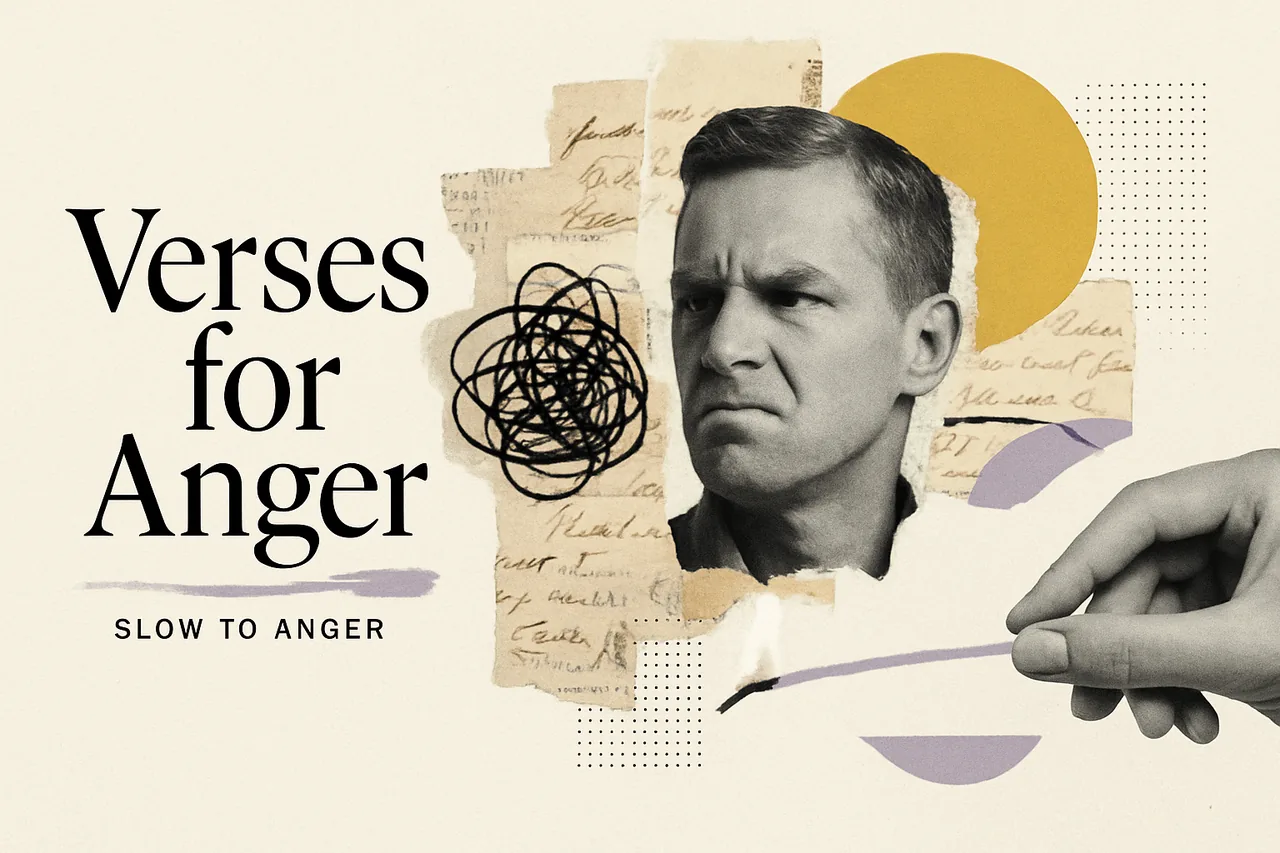
If you’re looking for Bible verses about anger to memorize, you already understand the problem better than most anger advice does: anger is fast. It acts before you can reason, before you can look anything up, before the wiser part of you gets a word in. Which is exactly why the answer has to be memorized. A verse you have to search for is useless in the three seconds that decide whether you say the thing you can’t unsay — but a verse already in you is quicker than your temper. Here are ten worth learning by heart, each with why it helps and a tip to make it stick, plus a plan to learn them.
Personal note from Efrén: I’m honestly not someone anger overtakes easily — but when it has happened, I’ve usually remembered the verse once I’d already blown it. So I’m still in the process this page describes: learning to remember before, not after. That’s the whole fight, and it’s exactly what memorization is for.
How Scripture speaks to anger
The Bible permits righteous anger at genuine evil but warns, relentlessly, against the anger that lingers, controls, and lashes out. It refuses the two easy lies — that anger is always sin, or that anger is always fine. Instead it draws a line: “Be angry and do not sin.” Anger at genuine evil and injustice can be righteous; God himself is described that way, and Jesus was angry in the temple. What Scripture warns against, relentlessly, is the anger that lingers, controls, and lashes out — the anger that “does not produce the righteousness of God” no matter how justified it felt.
So these verses aren’t about numbing your anger into nonexistence. They’re about governing it: slowing it down, keeping it from hardening, aiming it rightly, and never letting it become the master. Most of them work by installing a pause — and a memorized pause, dropped into the half-second before you react, is very often the entire difference between anger you’ll be glad you felt and anger you’ll spend a week apologizing for.
10 Bible verses about anger to memorize
1. James 1:19–20 — the order of operations
“Know this, my beloved brothers: let every person be quick to hear, slow to speak, slow to anger; for the anger of man does not produce the righteousness of God.”
The single most practical anger verse in the Bible, and it’s a sequence: quick to hear, slow to speak, slow to anger — in that order. Most anger goes wrong by reversing it: we speak first, hear last, and anger fastest. It even tells you why to slow down — “the anger of man does not produce the righteousness of God.” Your anger, however righteous it feels, rarely builds what God is building.
Tip: learn it as three speeds — quick, slow, slow. Fixing the tempo words first gives you the skeleton, and in the heated moment the single word “slow” is enough to summon the brake.
2. Ephesians 4:26–27 — anger with a curfew
“Be angry and do not sin; do not let the sun go down on your anger, and give no opportunity to the devil.”
This verse does two things at once: it permits anger (“be angry and do not sin”) and it puts a clock on it (“do not let the sun go down”). Anger isn’t the sin; nursing it is, because anger left overnight gives “opportunity to the devil” — it hardens into bitterness while you sleep. Deal with it today, or it starts building a home in you.
Tip: attach it to sundown — literally. For a week, let the evening cue the question “am I holding anger at anyone?” The verse turns dusk into a daily reset, exactly as it intends.
3. Proverbs 15:1 — the answer that defuses
“A soft answer turns away wrath, but a harsh word stirs up anger.”
A whole conflict-resolution strategy in eleven words: “a soft answer turns away wrath, but a harsh word stirs up anger.” It works on both people — your soft answer cools the other person, and choosing to give it cools you. Anger escalates by echo; this verse is how you break the echo.
Tip: rehearse it as the two outcomes it names — soft turns away, harsh stirs up. Memorizing the contrast means that mid-argument, feeling the harsh word rise, you’ll hear the verse name exactly what it’s about to do.
4. Proverbs 29:11 — the fool and the wise man
“A fool gives full vent to his spirit, but a wise man quietly holds it back.”
Blunt, and it stings in the right way: “a fool gives full vent to his spirit, but a wise man quietly holds it back.” Our culture calls venting healthy; Proverbs calls full venting foolish. The wise person isn’t repressing — they’re holding back, governing the release. It reframes self-control as wisdom, not weakness.
Tip: learn it as the two men it contrasts — the fool who vents, the wise man who holds back. In the hot moment, the question “which one am I being right now?” is the verse doing its work.
5. Ephesians 4:31–32 — what to put off and put on
“Let all bitterness and wrath and anger and clamor and slander be put away from you, along with all malice. Be kind to one another, tenderhearted, forgiving one another, as God in Christ forgave you.”
Paul doesn’t just say stop being angry; he gives you the replacement. Put away wrath, anger, malice — and put on kindness, tenderheartedness, forgiveness. And the engine is the last line: forgive “as God in Christ forgave you.” You forgive the person out of the surplus of how you’ve been forgiven, not out of willpower.
Tip: learn it as a swap — the list to put off, then the list to put on. Memorizing both halves means the verse doesn’t leave a vacuum; it hands you what to do instead of the anger, which is the only thing that ever actually replaces it.
6. Colossians 3:8 — the clothing to take off
“But now you must put them all away: anger, wrath, malice, slander, and obscene talk from your mouth.”
A companion to Ephesians 4:31, with a vivid image underneath: “put them all away” uses the picture of taking off filthy clothing — anger, wrath, malice, slander. It treats these not as who you are but as something you’re wearing and can remove. For the person who feels defined by a short temper, that reframe is freedom: it’s a garment, not your skin.
Tip: lean on the image — “put them all away,” like stripping off a stained coat. A verse learned with a physical picture attached comes back with the picture, and this one hands you the motion of taking anger off.
7. Proverbs 19:11 — the glory of overlooking
“Good sense makes one slow to anger, and it is his glory to overlook an offense.”
A quietly counter-cultural verse: “it is his glory to overlook an offense.” Not every slight needs a response; maturity often looks like letting something go unaddressed. “Good sense makes one slow to anger” — the slowness is sense, not spinelessness — and overlooking a minor offense is called a glory, not a defeat.
Tip: personalize it against your actual triggers — the small daily offenses you tend to seize on. Learning it with those in mind trains it to surface the next time one of them lands, whispering “overlook it” before you escalate.
8. Psalm 4:4 — be angry, and be still
“Be angry, and do not sin; ponder in your own hearts on your beds, and be silent. Selah”
The verse Paul was quoting in Ephesians 4:26. It adds a practice: “ponder in your own hearts on your beds, and be silent.” When anger flares, don’t act on it in the heat — take it inward, examine it, go quiet before God. Anger hates silence and reflection; this verse prescribes exactly both.
Tip: learn the sequence — be angry, then ponder, then be silent. Three moves from flare to stillness; walking through them in order is itself the de-escalation the verse teaches.
9. James 4:1–2 — where the fights come from
“What causes quarrels and what causes fights among you? Is it not this, that your passions are at war within you? You desire and do not have, so you murder. You covet and cannot obtain, so you fight and quarrel. You do not have, because you do not ask.”
A diagnostic verse rather than a defusing one, and understanding is its own kind of control. James traces quarrels back to their source: “your passions… at war within you.” The conflict outside starts as an unmet craving inside. Memorize it and you’ll start asking, mid-anger, the more useful question: not “what did they do?” but “what do I want that I’m not getting?”
Tip: learn it as the question it implies — what passion of mine is driving this? Carrying the verse as a self-diagnostic turns anger into information about your own heart instead of just ammunition against someone else’s.
10. Proverbs 16:32 — the real strength
“Whoever is slow to anger is better than the mighty, and he who rules his spirit than he who takes a city.”
A verse that redefines power: “whoever is slow to anger is better than the mighty, and he who rules his spirit than he who takes a city.” Ancient glory went to the warrior who conquered a city; Proverbs says governing your own temper is the greater conquest. For anyone who thinks self-control is weakness, this verse calls it the higher strength.
Tip: learn the two comparisons — better than the mighty, greater than the city-taker. Memorizing the surprising ranking is what makes it stick, and it reframes every held-back outburst as a victory rather than a loss.
A plan to learn these
All ten is a couple of months of steady work. Begin with the two most useful the moment your temper spikes:
- Days 1–5: James 1:19–20 — quick to hear, slow to speak, slow to anger. Learn it around its three speeds, out loud, recalling with the text hidden.
- Days 6–9: Proverbs 15:1 — the soft answer. Short, and you’ll use it constantly. Review James daily.
- Week 3: add Ephesians 4:26–27 (the overnight curfew) and Ephesians 4:31–32 (put off / put on) — the two that reshape the habit, not just the moment.
- Ongoing: work through the rest at one every few days, always reciting the verses you already hold before adding a new one.
That habit is the whole game: review the old before you add the new. A fresh verse wants daily practice; an older one holds on a weekly, then monthly touch — the widening rhythm called spaced repetition, and the reason “slow to anger” surfaces in the heated moment a year from now instead of fading by next week. The method for learning each verse is in our complete guide to memorizing Scripture. And if you’d rather not track the schedule by hand, VerseKeep keeps every verse on its own clock, so the brake is loaded before the moment you need it.
Load the brake today
Anger won’t warn you before it arrives, so install the pause now. Take James 1:19–20, learn it by heart, and let “slow to speak, slow to anger” be the sentence that surfaces the next time your temper spikes. Ten minutes today; a governor on a hundred future moments. When you’re ready to go wider, our main list of Bible verses to memorize organizes thirty by theme, and the scripture memory systems guide turns a handful of verses into a temper you govern instead of one that governs you.
Scripture quotations are from the ESV® Bible (The Holy Bible, English Standard Version®), © 2001 by Crossway. Used by permission. All rights reserved.
Frequently asked questions
What is the best Bible verse about anger to memorize?
James 1:19–20 — "let every person be quick to hear, slow to speak, slow to anger." It's short, intensely practical, and it gives you the exact order of operations for the heated moment: listen first, speak last, anger slowest. Memorize it and you have a brake you can pump before you say the thing you'll regret.
Is all anger a sin?
No. Scripture distinguishes righteous anger from sinful anger — "Be angry and do not sin" (Ephesians 4:26) assumes anger itself can be sinless. God is described as angry at injustice and evil, and Jesus was angry in the temple. What Scripture warns against is anger that lingers, controls, or lashes out — anger that "does not produce the righteousness of God" (James 1:20). The verses below are for governing anger, not pretending you never feel it.
What does "do not let the sun go down on your anger" mean?
Ephesians 4:26 tells you to deal with anger quickly, before it hardens into bitterness or gives "opportunity to the devil" (v27). It's not a literal deadline about bedtime; it's a warning that anger left to sit overnight tends to root. Reconcile, confess, or release it the same day rather than nursing it.
How can memorizing Scripture help me control my temper?
Anger is fast — it acts before you think. A memorized verse is the one thing quicker than your temper, because it's already loaded and doesn't need looking up. Reciting "slow to speak, slow to anger" in the half-second before you react inserts a pause exactly where you need one, and that pause is usually the whole battle.