
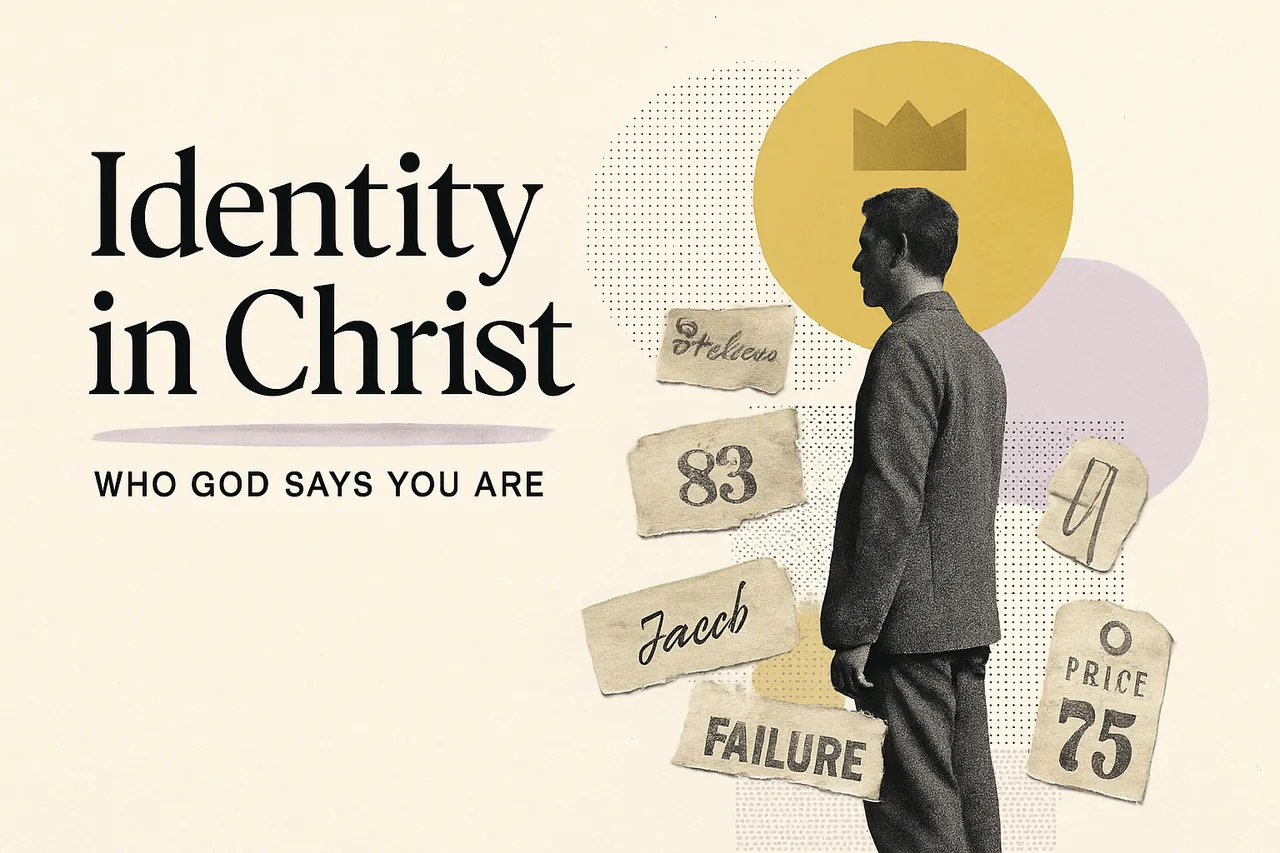
If you’ve searched for Bible verses about identity in Christ to memorize, you’re after something the world can’t finally give you: a settled answer to who am I? Every other answer wobbles — your performance dips, opinions turn, the past resurfaces, feelings lie. The gospel grounds identity somewhere that doesn’t move: in your union with Christ and what God has declared about you there. But that truth has to be repeated to be held, because on a hard day the old labels come flooding back. Memorized verses are that repetition. Here are ten worth learning by heart, each with who God says you are and a tip to make it stick, plus a plan to learn them.
Personal note from Efrén: God has declared us righteous, but daily life keeps reminding us we are sinners — and in that fight it’s easy to be eaten by guilt and condemnation, and to start believing the devil’s lies. Being able to recite and proclaim what God says we are in Him is a great help: His truth gets to prevail over my feelings.
How Scripture speaks to identity
The Bible builds identity from the outside in. It doesn’t tell you to look within and discover your true self; it tells you what God has done to you and declared over you — chosen, forgiven, adopted, made new, hidden with Christ. Your identity, in Scripture, is not something you generate or achieve but something you receive. That’s what makes it stable. A self-worth you build can be torn down; a status God confers in Christ cannot, because it never rested on you in the first place.
The key phrase running through it all is “in Christ.” Nearly every identity verse locates you there — in union with Jesus, so that his standing becomes yours. You are not righteous on your own steam; you are righteous in him. Not condemned, because you’re in him. A new creation, because you’re in him. Memorize these and you carry the gospel’s answer to shame and self-doubt: not “believe in yourself,” but “look at who you are in Christ” — a verdict already spoken, waiting to be recalled the moment the old voice starts up again.
10 Bible verses about identity in Christ to memorize
1. 2 Corinthians 5:17 — a new creation
“Therefore, if anyone is in Christ, he is a new creation. The old has passed away; behold, the new has come.”
The foundation stone: “if anyone is in Christ, he is a new creation. The old has passed away; behold, the new has come.” Not renovated, not improved — new. Union with Christ doesn’t just forgive your past; it makes you a genuinely new self. For anyone chained to who they used to be, this verse announces a clean line: old gone, new come.
Tip: learn it around the contrast — the old passed away, the new has come. Fixing that before/after is the whole verse; recite it whenever the old self tries to reintroduce itself, and let the “behold” mark the change as done.
2. Galatians 2:20 — no longer I, but Christ
“I have been crucified with Christ. It is no longer I who live, but Christ who lives in me. And the life I now live in the flesh I live by faith in the Son of God, who loved me and gave himself for me.”
The most radical identity statement Paul makes: “it is no longer I who live, but Christ who lives in me.” Your old self was crucified with Christ; the life you now live, you live “by faith in the Son of God, who loved me and gave himself for me.” Identity here isn’t self-expression — it’s Christ living through you. The self at the center has been replaced.
Tip: learn the pivot — “no longer I… but Christ.” Then anchor the end, which makes it personal: “loved me and gave himself for me.” Memorizing the pivot and the personal close together holds both the doctrine and the intimacy.
3. John 1:12 — the right to be God’s child
“But to all who did receive him, who believed in his name, he gave the right to become children of God,”
Identity as a gift received by faith: “to all who did receive him… he gave the right to become children of God.” Not everyone is automatically God’s child in this saving sense — but everyone who receives Christ is given the right to be. Your status as a child of God isn’t presumption; it’s a right he granted. For the one who feels they don’t belong, this verse says the belonging was authorized.
Tip: learn it as the transaction it describes — received him, therefore given the right to be his child. Fixing the “to all who received… he gave” logic makes the identity feel as sure as it is: conferred, not claimed.
4. Ephesians 2:10 — God’s workmanship
“For we are his workmanship, created in Christ Jesus for good works, which God prepared beforehand, that we should walk in them.”
Against the feeling of being an accident or a mess: “we are his workmanship, created in Christ Jesus for good works, which God prepared beforehand.” You are a making of God — the word behind “workmanship,” poiēma, simply means “something made” (it’s sometimes rendered “masterpiece” for effect) — designed on purpose, for a purpose. Your life isn’t random; it was authored, and good works were laid out ahead of you to walk into.
Tip: learn the two halves — who you are (his workmanship) and what you’re for (good works he prepared). Memorizing both keeps identity from turning inward; you were made by God and for something.
5. Romans 8:1 — no condemnation
“There is therefore now no condemnation for those who are in Christ Jesus.”
The verse that silences the accusing voice: “there is therefore now no condemnation for those who are in Christ Jesus.” Not “less” condemnation, not “condemnation deferred” — none, now, for those in Christ. Whatever the accusation, whatever the memory, the verdict over you has already been settled in your favor. For a conscience that keeps re-arresting you, this is the release papers.
Tip: learn the three load-bearing words — “no condemnation… now.” Stress “no” and “now”; the verse’s whole comfort is in the totality and the timing, and drilling them lets you answer shame instantly with God’s actual verdict.
6. 1 Peter 2:9 — chosen, royal, holy, his
“But you are a chosen race, a royal priesthood, a holy nation, a people for his own possession, that you may proclaim the excellencies of him who called you out of darkness into his marvelous light.”
A stack of titles God gives his people: “a chosen race, a royal priesthood, a holy nation, a people for his own possession.” Four identities, each staggering, and a purpose — “that you may proclaim the excellencies of him who called you out of darkness into his marvelous light.” When you feel like nobody, this verse hands you four names that say otherwise.
Tip: learn the four titles as a list — chosen, royal, holy, his own. Memorizing the four in order gives you a quick inventory to recite against the lie that you’re ordinary or unwanted; each one is a counter-verdict.
7. Colossians 3:3 — hidden with Christ
“For you have died, and your life is hidden with Christ in God.”
A quietly profound one: “you have died, and your life is hidden with Christ in God.” Your truest life isn’t on display, isn’t riding on your visible successes and failures — it’s hidden, safe, tucked away with Christ in God himself. For anyone exhausted by performing their identity in public, this verse relocates it somewhere untouchable.
Tip: anchor it to the image — your life hidden, safe with Christ in God. A verse learned with its picture returns with the picture; recall it when you feel exposed, and let “hidden with Christ” name where your real security actually sits.
8. Ephesians 1:4–5 — chosen before you existed
“even as he chose us in him before the foundation of the world, that we should be holy and blameless before him. In love he predestined us for adoption to himself as sons through Jesus Christ, according to the purpose of his will,”
Identity pushed back before the beginning of time: “he chose us in him before the foundation of the world… he predestined us for adoption.” Your belonging to God isn’t a recent development or a reward for good behavior — it was decided before the world was made, “according to the purpose of his will.” For the fear that God might change his mind, this verse says he settled it before you drew a breath.
Tip: learn the two acts and their timing — chosen and adopted, before the foundation of the world. Fixing that this predates you removes the anxiety that you earned it or could un-earn it; it was never yours to secure.
9. 1 John 3:1 — look at this love
“See what kind of love the Father has given to us, that we should be called children of God; and so we are. The reason why the world does not know us is that it did not know him.”
An invitation to stop and marvel: “see what kind of love the Father has given to us, that we should be called children of God; and so we are.” John can barely get over it — what kind of love makes a person a child of God? And then the flat certainty: “and so we are.” It’s not a hopeful maybe; it’s a present fact you’re told to gaze at.
Tip: learn it as the two moves — the wonder (“see what kind of love”) and the fact (“and so we are”). Reciting the wonder first, then the certainty, keeps the verse from going flat; it’s meant to be a little bit astonished.
10. Galatians 3:26 — sons through faith
“for in Christ Jesus you are all sons of God, through faith.”
The verse that makes the identity universal to believers: “in Christ Jesus you are all sons of God, through faith.” Not through pedigree, performance, or status — through faith, and therefore open to anyone in Christ. The full inheritance rights of a son (in that culture, the heir) belong to every believer equally. For anyone who feels second-class in God’s family, this verse flattens the distinction.
Tip: learn the ground of it — sons of God through faith, in Christ. Fixing “through faith” guards the identity from creeping back toward performance; it came by believing, and it’s held the same way.
A plan to learn these
All ten is a couple of months of steady memorizing. Begin with the foundation and the verdict that answers shame:
- Days 1–5: 2 Corinthians 5:17 — a new creation. Learn it around the old/new contrast, out loud, recalling with the text hidden.
- Days 6–9: Romans 8:1 — no condemnation. Short, and it’s the one you’ll preach to yourself most. Review 2 Corinthians daily.
- Week 3: add 1 Peter 2:9 (four titles) and 1 John 3:1 (children of God) — the two that most directly answer “I’m nobody.”
- Ongoing: work through the rest at one every few days, always reciting the verses you already hold before adding a new one.
That habit is what makes them stick: rehearse the old before the new. A fresh verse wants daily recall; a settled one needs only a weekly, then monthly pass — the widening rhythm called spaced repetition, and the reason the truer identity is on your lips the next time the old labels return. The method for learning each verse is in our complete guide to memorizing Scripture. And if you’d rather not track the schedule by hand, VerseKeep keeps every verse on its own clock, so who you are in Christ stays louder than who the world says you are.
Answer the question today
The next hard day will ask “who are you, really?” — so have the answer ready before it does. Take 2 Corinthians 5:17, learn that in Christ you are a new creation, and let it be the verdict you recall when the old one returns. Ten minutes now; a settled identity for a hundred unsettled moments. When you’re ready to go wider, our main list of Bible verses to memorize organizes thirty by theme, and the scripture memory systems guide turns a handful of verses into an identity that doesn’t wobble.
Scripture quotations are from the ESV® Bible (The Holy Bible, English Standard Version®), © 2001 by Crossway. Used by permission. All rights reserved.
Frequently asked questions
What is the best Bible verse about identity in Christ to memorize?
2 Corinthians 5:17 — "if anyone is in Christ, he is a new creation. The old has passed away; behold, the new has come." It's the foundational statement of Christian identity: union with Christ makes you genuinely new, not merely improved. Memorize it and you carry the answer to "who am I now?" that the gospel actually gives.
What does it mean to have your identity in Christ?
It means your deepest sense of who you are rests on your union with Jesus — chosen, forgiven, adopted, made new — rather than on your performance, others' opinions, your past, or your feelings. Those things shift; your standing in Christ doesn't. Scripture grounds identity in what God has done and declared, which is why it holds when everything else wobbles.
How do these verses help with low self-worth or shame?
They replace a verdict you feel with a verdict God has spoken. Shame says "you are what you've done"; verses like Romans 8:1 ("no condemnation") and 1 John 3:1 ("children of God") say your status is set by Christ's work, not your record. Memorizing them lets you answer the accusing voice with God's own words in the moment it's loudest.
Why memorize verses about who I am in Christ?
Because you forget. On a hard day the old labels come back — failure, unwanted, not enough — and a memorized verse is how you preach the truer identity to yourself before the lie settles. Identity is held by repetition; these verses give you the repetition.