
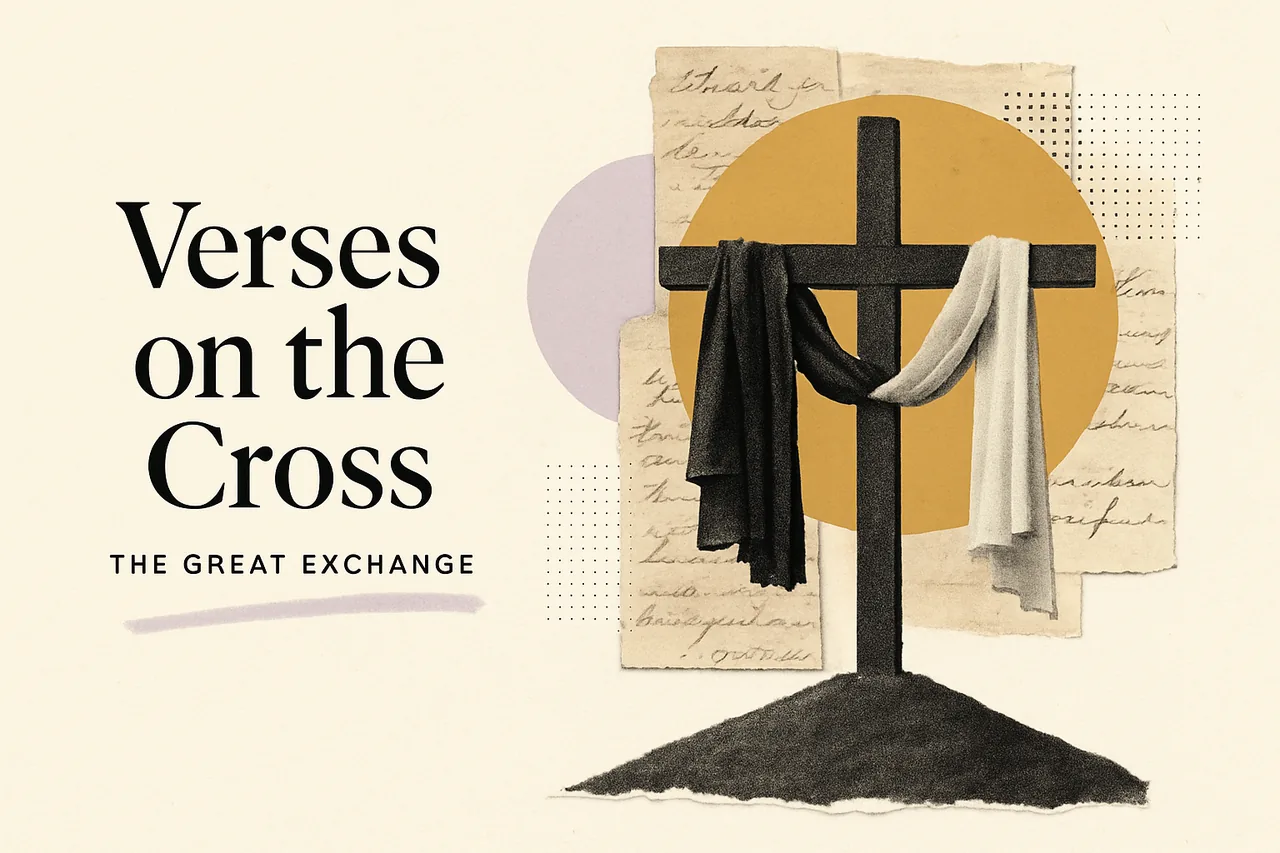
If you’re looking for Bible verses about the cross to memorize, you’re reaching for the center of the whole faith. Everything Christianity claims stands or falls at one event, and the verses that explain it are worth not just reading but owning — because a heart that forgets the cross drifts, toward self-righteousness when life is good and toward despair when it isn’t. Memorized, these verses keep Christ’s finished work in front of you, steadying both. Here are ten worth learning by heart, each with what it says the cross accomplished and a tip to make it stick, plus a plan to learn them.
Personal note from Efrén: at the cross our rescue was finished — and there, as the Reformers taught us, we can discern our sin imputed to Christ and His righteousness imputed to us. That is a doctrine we cannot lose, forget, or negotiate with anyone; it is the foundation of our faith, and that’s why these verses belong in the heart, not just on the page.
How Scripture speaks to the cross
The New Testament never treats the cross as a tragedy that happened to Jesus; it treats it as the deliberate, saving work Jesus accomplished. The verses below name facet after facet of one act: he bore our sins, was pierced for our transgressions, canceled the debt we owed, became sin so that we could become righteousness, and then declared the work “finished.” Behind all of it is a single logic — at the cross, God’s justice and mercy meet. Sin is not overlooked but fully punished; sinners are not condemned but fully forgiven. The penalty falls, and it falls on a willing substitute.
That’s why these are worth memorizing with care rather than sentiment. The cross is a doctrine before it’s a feeling, and getting the wording exactly right matters: “he made him to be sin” is a different and greater claim than “he felt our pain.” Learn these precisely and you carry the gospel itself — the truth you’ll most want ready to preach to yourself on a low day, and to share with someone who needs it.
10 Bible verses about the cross to memorize
1. 2 Corinthians 5:21 — the great exchange
“For our sake he made him to be sin who knew no sin, so that in him we might become the righteousness of God.”
The densest sentence in the New Testament about what the cross did. Two transfers happen at once: our sin is reckoned to the sinless Christ (“made him to be sin who knew no sin”), and his righteousness is reckoned to us (“that we might become the righteousness of God”). This is the heart of the gospel — not that God ignored sin, but that he moved it onto Christ and moved Christ’s righteousness onto us.
Tip: learn it in two columns — everything about him (made sin, knew no sin) on one side, everything about us (for our sake, become righteousness) on the other. Reciting across the exchange fixes the structure, and the structure is the doctrine.
2. Isaiah 53:5 — the cross foretold
“But he was pierced for our transgressions; he was crushed for our iniquities; upon him was the chastisement that brought us peace, and with his wounds we are healed.”
Written seven centuries before Calvary, and startlingly exact: “he was pierced for our transgressions… upon him was the chastisement that brought us peace, and with his wounds we are healed.” Every clause is substitution — our transgressions, his wounds, our peace. That the cross was prophesied in such detail is its own quiet argument for the whole plan.
Tip: learn the four “our/his” swaps — pierced for our transgressions, crushed for our iniquities, his chastisement / our peace, his wounds / our healing. The relentless exchange pattern makes the verse memorable and drives home that it was all for us.
3. 1 Peter 2:24 — he carried our sins up the tree
“He himself bore our sins in his body on the tree, that we might die to sin and live to righteousness. By his wounds you have been healed.”
Peter states the substitution plainly and adds its purpose: “he himself bore our sins in his body on the tree, that we might die to sin and live to righteousness.” The cross doesn’t only forgive; it frees — “by his wounds you have been healed.” Note the aim: not just pardon, but a changed life, dying to sin because he died for it.
Tip: learn it as the movement it describes — he bore our sins up the tree so that we might die to sin and live to righteousness. Fixing the “that we might” clause keeps the verse from stopping at forgiveness; it carries you into the new life the cross purchased.
4. Colossians 2:13–14 — the canceled debt
“And you, who were dead in your trespasses and the uncircumcision of your flesh, God made alive together with him, having forgiven us all our trespasses, by canceling the record of debt that stood against us with its legal demands. This he set aside, nailing it to the cross.”
A vivid picture of what the cross did with your guilt: it “canceled the record of debt that stood against us… nailing it to the cross.” The certificate of everything you owed was not merely torn up but nailed to the cross with Christ — paid, in full, in public. For a conscience haunted by its record, this verse says the record is gone.
Tip: anchor it to the image — your list of debts nailed to the cross. A verse learned with its picture attached returns with the picture, and this one hands you a visual of your own guilt canceled.
5. Galatians 6:14 — the only thing worth boasting in
“But far be it from me to boast except in the cross of our Lord Jesus Christ, by which the world has been crucified to me, and I to the world.”
Paul strips away every other source of pride: “far be it from me to boast except in the cross of our Lord Jesus Christ.” If salvation was bought by Christ’s death, you contributed nothing to boast about. The cross both saves you and humbles you — it leaves no room for self-congratulation, “by which the world has been crucified to me, and I to the world.”
Tip: learn it as the exclusion it is — boast in nothing except the cross. Memorizing the “except” makes it a lens: every time pride rises over some achievement, the verse names the one thing actually worth boasting in.
6. Romans 5:8 — the timing that proves the love
“but God shows his love for us in that while we were still sinners, Christ died for us.”
The verse that shows the cross was love, not reward: “God shows his love for us in that while we were still sinners, Christ died for us.” Not after we cleaned up — while we were still sinners. The cross wasn’t God responding to our goodness; it was God loving his enemies. For anyone who fears they must earn it first, the timing settles everything.
Tip: learn it around the word “while” — Christ died while we were still sinners. That single word carries the whole scandal of grace; stress it, and the verse preaches the unearned love of the cross every time.
7. Philippians 2:8 — how low he went
“And being found in human form, he humbled himself by becoming obedient to the point of death, even death on a cross.”
The measure of Christ’s obedience, descending step by step: “he humbled himself by becoming obedient to the point of death, even death on a cross.” The phrase “even death on a cross” is the bottom of the descent — crucifixion was the most shameful death Rome had. This verse tells you not just that he died, but how far down he was willing to go.
Tip: learn it as a descent — humbled, obedient, to death, even death on a cross. Each phrase drops lower; recite it as a staircase going down, and the final clause lands with the weight of how far Christ stooped to save you.
8. John 19:30 — “It is finished”
“When Jesus had received the sour wine, he said, It is finished, and he bowed his head and gave up his spirit.”
Three words that end the work: “It is finished.” Behind them stands a single Greek word, tetelestai — “it is accomplished,” a task fully completed (it’s often illustrated by ancient receipts marked “paid in full,” though the certainty rests on the word itself: finished, not merely stopped). Jesus didn’t die with a cry of defeat but a declaration of completion. There is nothing left for you to add to your salvation; the cross was not a down payment but the final one.
Tip: learn the whole short verse and let it end where Jesus ended — on “It is finished.” Its brevity makes it easy; its finality makes it worth reciting slowly, resting on the word “finished,” which is the whole comfort.
9. Hebrews 12:2 — the joy on the far side
“looking to Jesus, the founder and perfecter of our faith, who for the joy that was set before him endured the cross, despising the shame, and is seated at the right hand of the throne of God.”
The cross seen through Jesus’ own eyes: he “for the joy that was set before him endured the cross, despising the shame.” He saw past the agony to the joy on the other side — a redeemed people, a finished work — and that joy carried him through. Now he “is seated at the right hand of the throne of God”: the shame is over, the victory permanent.
Tip: learn the arc — the joy set before him, enduring the cross, now seated. Memorizing the movement from anticipation through suffering to enthronement keeps the whole story in the verse, ending in triumph.
10. 1 Corinthians 1:18 — folly or power
“For the word of the cross is folly to those who are perishing, but to us who are being saved it is the power of God.”
The verse that explains why the cross divides people: “the word of the cross is folly to those who are perishing, but to us who are being saved it is the power of God.” A dying savior sounds absurd to the world, and always has. But to the saved, that same message is God’s power. It tells you not to be surprised when the cross seems foolish to some — and to marvel that it became power to you.
Tip: learn the two responses it contrasts — folly to the perishing, power to the saved. Fixing the split reminds you that the cross’s “foolishness” is expected, and that seeing its power is itself a gift of grace.
A plan to learn these
Give this a couple of months of unhurried work. Begin with the verse that holds the whole doctrine, then the foretelling and the finish:
- Days 1–6: 2 Corinthians 5:21 — the great exchange. It’s dense; learn it slowly in two columns, out loud, recalling with the text hidden.
- Days 7–10: John 19:30 — “It is finished.” Three words, but recite it daily alongside 2 Corinthians until the doctrine settles.
- Week 3: add Isaiah 53:5 (the cross foretold) and Romans 5:8 (love proven by the timing) — the two that most move the heart.
- Ongoing: work through the rest at one every few days, always reciting the verses you already hold before adding a new one.
That habit is what keeps them: the old before the new. A new verse needs daily recall; an older one holds with a weekly, then monthly review — the stretching schedule called spaced repetition, and the reason the gospel stays sharp in you rather than fading to a vague memory of a sermon. The method for learning each verse is in our complete guide to memorizing Scripture. And if you’d rather not track the schedule by hand, VerseKeep keeps every verse on its own clock, so the finished work of Christ stays in front of you.
Fix the center today
Everything else in the Christian life orbits the cross, so plant its clearest verse first. Take 2 Corinthians 5:21, learn the great exchange by heart, and you’ll carry the gospel itself — ready to preach to yourself on a low day, ready to share when someone asks. Ten minutes now; the center of the faith, permanently within reach. When you’re ready to go wider, our main list of Bible verses to memorize organizes thirty by theme, and the scripture memory systems guide turns a handful of verses into a gospel you can preach to yourself and to anyone who asks.
Scripture quotations are from the ESV® Bible (The Holy Bible, English Standard Version®), © 2001 by Crossway. Used by permission. All rights reserved.
Frequently asked questions
What is the best Bible verse about the cross to memorize?
2 Corinthians 5:21 — "For our sake he made him to be sin who knew no sin, so that in him we might become the righteousness of God." It's the great exchange in one sentence: our sin was reckoned to Christ, his righteousness to us. If you memorize one verse about what the cross accomplished, this is the one that holds the whole doctrine.
What did the cross accomplish, according to the Bible?
The verses on this page name several facets of one saving act: Christ bore our sins (1 Peter 2:24), was pierced for our transgressions (Isaiah 53:5), canceled the record of debt against us (Colossians 2:14), became sin so we could become righteousness (2 Corinthians 5:21), and declared "It is finished" (John 19:30). The cross is where God's justice and mercy meet — sin fully punished, sinners fully forgiven.
Why does Paul say he boasts "only in the cross"?
Galatians 6:14 — because the cross undercuts every other ground for boasting. If salvation is a gift purchased by Christ's death, there's nothing left for us to take credit for. The cross humbles human pride and puts all the glory on Christ, which is exactly why Paul makes it the one thing worth boasting about.
Why memorize verses about the cross?
Because the cross is the center of the Christian faith, and a heart that forgets it drifts — toward self-righteousness when things go well, toward despair when they don't. Memorized cross verses keep the finished work of Christ in front of you, steadying both. They're also the truths you'll most want ready to share, and to preach to yourself.